

AEO vs GEO vs LLMO: Are They All SEO? Complete 2026 Guide
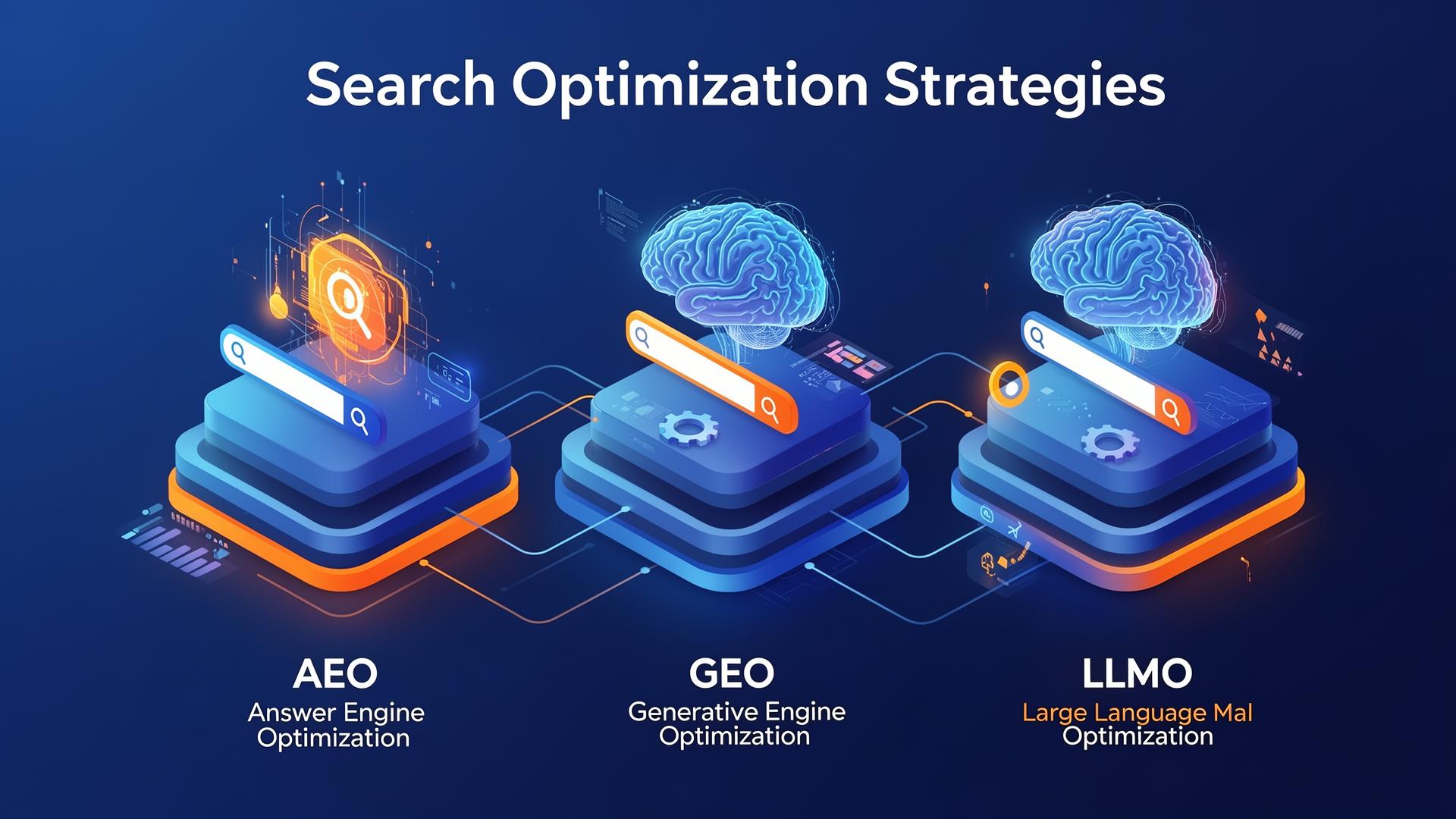
SEO is evolving. AEO, GEO, and LLMO are the new frontiers of search optimization. Understand the differences between Answer Engine Optimization, Generative Engine Optimization, and Large Language Model Optimization—and learn how to optimize for all of them.
Key Takeaways
Before we dive deep into the world of AI-powered search optimization, here's what you'll walk away with from this guide.
First, SEO isn't dead — it's evolving faster than ever before. Traditional SEO focused on ranking in Google's famous "10 blue links." That still matters, but it's no longer the complete picture. AI-powered search is fundamentally changing how users find and consume information online.
Second, you'll understand what AEO (Answer Engine Optimization) actually means. It focuses on getting your content featured in voice searches, featured snippets, and AI-generated answers. Think of it as being the definitive answer to specific questions.
Third, we'll explore GEO (Generative Engine Optimization) — the newest frontier in digital marketing. This is about optimizing for AI platforms like ChatGPT, Google AI Overviews, Perplexity, and Claude. When users ask these systems for recommendations, will YOUR business be mentioned?
Fourth, LLMO (Large Language Model Optimization) overlaps significantly with GEO but emphasizes training data, citation patterns, and how LLMs learn to recommend your brand over time.
Finally, you'll discover why you need a unified strategy. These aren't competing disciplines — they're complementary layers of modern search optimization. The businesses that will win in 2026 and beyond are the ones optimizing for all three.
Introduction
Last week, I had a conversation that changed how I think about search marketing.
A coaching institute owner in Bangalore asked me a simple question: "I rank on the first page of Google for 'best coaching classes in Bangalore.' But when I asked ChatGPT the same question, my institute wasn't mentioned at all. What's happening?"
That question captures the fundamental shift we're experiencing right now. Search is no longer just about Google rankings. It's about being visible wherever your customers are looking for answers — and increasingly, that means AI-powered platforms.
Two years ago, the conversation was simple. SEO meant Google optimization. Maybe you threw in some YouTube SEO if you were ambitious. That was the extent of it.
Today, the landscape has fractured into a confusing alphabet soup of acronyms. AEO. GEO. LLMO. SGE. AI Overviews. Answer Engines. Everyone has a different opinion about what matters, and most businesses are completely lost.
Here's the reality for Indian businesses in 2026: your customers aren't just Googling anymore. They're asking ChatGPT for recommendations. They're using Perplexity for research. They're relying on Google's AI Overviews to summarize information before they ever click a link.
When someone asks "What's the best CRM for small business in India?" — will your business be mentioned in the AI's response?
A recent study found that 64% of ChatGPT-generated responses include brand recommendations. But here's the shocking part: only 5% of businesses are actively optimizing for AI visibility.
That's a massive opportunity gap. And it's exactly why I'm writing this guide.
Over the next 15 minutes, I'll break down exactly what AEO, GEO, and LLMO mean in plain English. We'll explore how they differ from traditional SEO, where they overlap, and most importantly — how you can optimize for all of them to ensure your business gets discovered in the AI era.

The Evolution of Search: How We Got Here
To understand where search is going, we need to appreciate where it came from. The journey from Yahoo directories to ChatGPT spans just three decades, but the changes have been revolutionary.
In the 1990s and early 2000s, search was essentially a digital library card catalog. Yahoo categorized the web into neat hierarchies. AltaVista indexed pages and returned results based on keyword matches. Users navigated through directories to find information, and SEO meant getting listed in the right category with the right keywords.
It was primitive by today's standards, but it worked for a web that was still relatively small.
Then Google changed everything.
The launch of PageRank in the early 2000s introduced a radical idea: links equal authority. If many websites linked to your page, it must be valuable. This insight transformed SEO into a link-building arms race. Marketers chased backlinks, optimized anchor text, and obsessed over domain authority metrics.
The famous "10 blue links" became the standard. Rank on the first page, get the clicks. Simple as that.
By the 2010s, Google had gotten smarter. RankBrain, BERT, and countless algorithm updates meant that keyword stuffing no longer worked. Search engines started understanding intent, not just keywords. SEO evolved to focus on creating comprehensive content that genuinely matched what users were looking for.
This era emphasized quality. Helpful content won. Thin, manipulative pages lost.
Then came November 2022.
ChatGPT launched and crossed 100 million users faster than any application in history. Within months, Google scrambled to release Bard (now Gemini) and AI Overviews. Perplexity emerged as a dedicated "answer engine." Claude entered the market. Microsoft integrated AI into Bing.
For the first time ever, users started getting complete answers without visiting any website at all.
This paradigm shift is what birthed AEO, GEO, and LLMO — new frameworks for optimizing in an AI-first search landscape. Understanding these frameworks isn't optional anymore. It's essential for any business that wants to be discovered online.
What is SEO? (A Quick Refresher)
Before we dive into the new acronyms, let's make sure we're on the same page about what traditional SEO actually means in 2026.
Search Engine Optimization (SEO) is the practice of optimizing your website and content to rank higher in search engine results pages. When someone searches for "business automation software India," SEO is what determines whether your website appears on page one or page ten.
Traditional SEO has three core pillars that have remained consistent for over a decade.
Technical SEO ensures search engines can actually find and understand your website. This includes site speed optimization, mobile-friendliness, structured data markup, XML sitemaps, and proper URL structures. If Google's crawlers can't access your site or understand its structure, nothing else matters.
On-page SEO optimizes individual pages for specific keywords and topics. This is where title tags, meta descriptions, header structures, internal linking, and content quality come into play. Each page should be optimized for a specific set of keywords while providing genuine value to readers.
Off-page SEO builds your website's authority through external signals. Backlinks from reputable websites, brand mentions across the web, social signals, and digital PR all contribute to how search engines perceive your site's trustworthiness and authority.
Now, is SEO still relevant in 2026? Absolutely.
Google still processes over 8.5 billion searches every single day. Organic search drives 53% of all website traffic globally. And despite all the AI disruption, people still click on search results. Google isn't going anywhere.
But here's the critical nuance that many businesses are missing: SEO alone is no longer sufficient.
If you're only optimizing for traditional search rankings, you're becoming invisible to a growing segment of users who get their information from AI assistants. These users never see the search results page. They get their answer directly from ChatGPT or Perplexity and move on.
That's exactly where AEO, GEO, and LLMO come into the picture.
What is AEO (Answer Engine Optimization)?
Answer Engine Optimization, or AEO, focuses on optimizing your content to appear in direct answer formats rather than just ranked links.
Think about the last time you searched for something simple. Maybe you asked Google "What's the capital of Australia?" or "How many calories in a banana?" You probably didn't click any website. Google just showed you the answer directly at the top of the page.
That answer box? That's what AEO targets.
The key insight behind AEO is that users don't always want a list of websites. They want answers. When someone asks "What temperature should I bake pizza at?" they don't want to browse through ten recipe websites. They just want to know: 450-500°F or 230-260°C.
AEO matters across multiple surfaces. Google Featured Snippets — sometimes called "position zero" — appear above the traditional organic results. Voice search through Alexa, Siri, and Google Assistant typically pulls a single answer to read aloud. People Also Ask boxes on Google show expandable Q&A sections. Knowledge Panels display information boxes for entities. And Google's AI Overviews now synthesize information from multiple sources into comprehensive summaries.
To optimize for answer engines, start by structuring your content around questions. Use actual questions as your H2 and H3 headers. "What is CRM software?" will perform better for answer optimization than "CRM Software Explained."
Immediately after each question heading, provide a concise, direct answer in 40-60 words. This is the paragraph Google often pulls for featured snippets. After the direct answer, you can expand with details, examples, and supporting information.
Implement structured data markup on your pages. FAQ schema, HowTo schema, and Q&A schema help search engines understand your content's structure and purpose. This isn't optional — it's table stakes for AEO.
Voice searches tend to be longer and more conversational than typed queries. Someone might type "Instagram business posting times" but they'll ask their voice assistant "What's the best time to post on Instagram for my business?" Create content that answers these natural language questions.
Finally, build topical authority by covering subjects comprehensively. Answer engines prefer sources that demonstrate expertise across an entire topic, not one-off pages that barely scratch the surface.
What is GEO (Generative Engine Optimization)?
Generative Engine Optimization is the newest and most rapidly evolving field in search optimization. It focuses on getting your content cited, referenced, and recommended by AI-powered generative systems like ChatGPT, Google Gemini, Claude, and Perplexity.
The core difference between traditional SEO and GEO can be summarized in one sentence: SEO gets you ranked, but GEO gets you recommended.
When a user asks ChatGPT "What are the best business automation platforms in India?", the AI doesn't show a list of blue links. Instead, it synthesizes information from multiple sources to generate a conversational response. It might mention specific brands, compare features, and make recommendations.
The critical question for your business is simple: Is YOUR brand included in that response?
Understanding how generative engines work helps explain what GEO optimization requires. Unlike traditional search engines that retrieve and rank existing pages, generative engines retrieve relevant information from their training data and sometimes real-time sources. They then synthesize that information across multiple sources, generate a coherent answer that directly addresses the query, and sometimes cite their sources (especially Perplexity and Google AI Overviews).
Based on emerging research, several factors influence whether your content gets included in AI-generated responses.
Content that cites credible sources tends to perform better. When you reference statistics, studies, and authoritative sources in your content, AI systems are more likely to recommend you as a trustworthy source.
Creating quotable content matters tremendously. Clear, definitive statements are more likely to be pulled by AI systems than vague or rambling explanations. Think about how you can express your key points in memorable, quotable phrases.
Unique data and insights give you an edge. Original research, proprietary data, and unique perspectives are valued by AI systems because they add something new to the conversation that can't be found everywhere else.
Brand consistency across the web helps LLMs associate your brand with specific topics. If your messaging is inconsistent, AI systems may get confused about what your company actually does.
High-authority mentions boost your visibility. Being mentioned on Wikipedia, in major publications, and on industry-leading sites improves how AI systems perceive your authority.
| Factor | Traditional SEO | GEO |
|---|---|---|
| Primary Goal | Rank in SERPs | Get cited by AI |
| Success Metric | Rankings, clicks | AI mentions, citations |
| Key Content Type | Long-form optimized pages | Authoritative, quotable content |
| Link Building | Critical | Helpful for authority |
| Technical Focus | Crawlability, speed | Structured data, clarity |
| Timeline | Months to rank | Unknown (training-dependent) |
Want Your Business Recommended by AI?
Bharat Funnels helps Indian businesses build the kind of authoritative content that AI systems love to cite.
Book a Demo →What is LLMO (Large Language Model Optimization)?
Large Language Model Optimization focuses specifically on how LLMs like GPT-4, Claude, and Gemini learn about and recommend your brand. While closely related to GEO, LLMO takes a more technical lens — understanding how these AI systems work at a fundamental level.
The most important concept in LLMO is understanding the training data question.
LLMs learn from massive datasets scraped from the internet. Billions of web pages, articles, books, and documents are processed to teach these systems about the world. If your brand was well-represented in authoritative sources when the model was trained, it's more likely to recommend you in its responses.
This creates a fascinating dynamic: your past actions affect your future AI recommendations.
A brand that built a strong online presence during 2020-2023 may have a significant advantage in AI visibility because that content was included in the training data of current models. Newer brands that emerged after the training cutoff need to be even more strategic about their approach.
Effective LLMO strategy involves being present where LLMs learn. Wikipedia mentions carry significant weight, though you must follow their guidelines and never edit your own page. Major news publications, industry research reports, academic citations, and mentions on high-authority domains all contribute to how LLMs learn about your brand.
Beyond just being mentioned, you need to create what I call "training-worthy" content. LLMs don't just scrape content — they learn patterns and associations. Content that clearly establishes what your brand does, who you serve, why you're different, and includes specific facts and statistics is more likely to influence how LLMs discuss your category in future responses.
Brand search optimization is another crucial element. When someone asks an LLM "What is Bharat Funnels?", the answer should be accurate and complete. This starts with consistent, clear messaging on your own website and extends to every place your brand is mentioned online.
Finally, focus on creating structured, easily parseable content. LLMs prefer clear, well-organized content with explicit definitions, bullet points and numbered lists, clear category associations, and consistent entity relationships. The easier it is for an AI to understand and extract information from your content, the more likely that information is to be included in future responses.
AEO vs GEO vs LLMO: Key Differences Explained
Now that we've defined each term individually, let's put them side by side and understand exactly how they differ and where they overlap.
| Aspect | AEO | GEO | LLMO |
|---|---|---|---|
| Full Name | Answer Engine Optimization | Generative Engine Optimization | Large Language Model Optimization |
| Primary Target | Featured snippets, voice search | AI assistants (ChatGPT, Gemini) | LLM training and responses |
| Goal | Be the answer | Be recommended | Be "known" by AI |
| Content Focus | Q&A format, direct answers | Authoritative, quotable content | Training data presence |
| Time Horizon | Days to weeks | Weeks to months | Months to years |
| Measurable? | Yes (snippet tracking) | Partially (manual testing) | Difficult (training is opaque) |
| Overlap with SEO | High | Medium | Medium-Low |
| When Coined | 2018-2020 | 2023-2024 | 2023-2024 |
All three disciplines benefit from certain common foundations. High-quality, authoritative content matters across the board. Clear, structured formatting helps every type of search system understand your content. A strong brand presence online, consistent messaging, and demonstrated expertise on specific topics all contribute to success in AEO, GEO, and LLMO.
But the differences are significant enough to require distinct strategies.
AEO is the most immediate of the three. You can optimize for featured snippets today and potentially see results within days or weeks. It's the most "SEO-like" of the new disciplines because it still involves optimizing content for a search results page, just a different section of that page.
GEO requires building a broader presence across the web. AI systems synthesize information from many sources before generating their responses. Being mentioned positively across multiple authoritative websites matters more than just having great content on your own site.
LLMO is the most long-term play of all. Because LLMs are trained on historical data with significant lag times, the investments you make today may not influence AI responses until future model versions are released — sometimes months or even years later.
Here's the critical insight that ties everything together: these aren't competing strategies. A business that ignores AEO loses featured snippets and voice search visibility. A business that ignores GEO becomes invisible to the growing number of users who ask AI for recommendations. A business that ignores LLMO falls behind as AI becomes the dominant discovery channel.
You need all three. The question is how to prioritize your resources and build a unified approach.
Are AEO, GEO, and LLMO All Just SEO?
This is the philosophical question at the heart of this entire article, and honestly, there's no consensus answer in the marketing community yet.
Let me present both sides of the argument.
The case for "It's all just SEO" is compelling. At its core, search is search. Whether users find your business through Google links, featured snippets, or ChatGPT recommendations, the ultimate goal remains the same: attract people who need what you offer.
From this perspective, AEO, GEO, and LLMO are simply new tactics within the broader SEO discipline. Just like the industry incorporated "local SEO" and "video SEO" into the framework without declaring them entirely separate fields, we can incorporate AI optimization as the next evolution of search engine optimization.
The skills transfer. The strategic thinking is similar. The goal of creating valuable content that gets discovered remains unchanged.
But there's also a strong case for treating these as distinct disciplines.
Traditional SEO is fundamentally about ranking algorithms and organic clicks. You optimize, you rank, users click your link, you get traffic. The metrics are clear and established.
AEO, GEO, and LLMO involve different platforms, different optimization tactics, and different success metrics. When someone finds your brand through ChatGPT, there's no "click" to track in Google Analytics. When you're cited in a Perplexity answer, that's not a "ranking" in any traditional sense.
The feedback loops are different. The timelines are different. The technical requirements are different.
My personal take is this: I believe we're witnessing the birth of a new parent discipline that I'd call "Search and Discovery Optimization" or SDO.
Under this umbrella, traditional SEO handles organic search rankings on Google and Bing. AEO handles answer formats and voice search. GEO handles generative AI recommendations. And LLMO handles long-term LLM training influence.
Smart marketers will optimize for all channels, understanding that users don't care about our industry acronyms. They just want to find solutions to their problems, and they'll use whatever tool gets them there fastest.
For practical purposes, I recommend thinking of these as specialized branches of SEO rather than entirely separate fields. The skills, content strategy, and strategic thinking overlap significantly. But each branch requires specific tactics and attention.
The Indian Business Perspective
Everything we've discussed so far applies globally, but for Indian businesses specifically, there are unique opportunities and considerations worth highlighting.
The opportunity is right now, and it's significant.
Most Indian businesses haven't even started thinking about GEO and LLMO. Many are still catching up on basic SEO fundamentals. This creates a window of opportunity for forward-thinking businesses to dominate AI-driven discovery before competitors catch on.
The coaching institute owner I mentioned at the start of this article? He's now working on AI optimization. When his competitors finally wake up to this opportunity, he'll already be established as the authoritative voice in his space.
Language presents both a challenge and an opportunity for Indian businesses.
When Indian users query AI systems in Hindi or Hinglish, what appears in the responses? For many business categories, there's a significant content void. Most quality content about business, technology, and services exists only in English.
Businesses that create authoritative Hindi content have an opportunity to become the default AI recommendation for Hindi-speaking users. The same applies to other regional languages with significant online populations.
Local authority building is particularly important for businesses serving specific geographic areas. Being mentioned in local publications, industry associations, and regional business directories builds the authority signals that AI systems rely on. A mention in a Hyderabad business publication carries weight when someone asks AI about businesses in Hyderabad.
Here's an interesting angle that many miss: the conversational data created through WhatsApp integration is a goldmine for AEO and GEO strategy.
Bharat Funnels' WhatsApp integration, for example, captures every question customers ask. Businesses that systematically analyze these questions and create content addressing them build natural AEO and GEO assets. Real customer questions become the foundation for content that answers exactly what your audience wants to know.
For Indian SMBs, I recommend a phased approach. Start by establishing strong SEO fundamentals — you simply cannot skip the basics. Then implement FAQ schema on your website for immediate AEO benefits. Create content around "best [category] in India" queries that AI systems frequently receive. Get mentioned in relevant industry publications and directories. And monitor AI responses for your core topics at least monthly to track your progress.
Ready to Get Your Business Discovered by AI?
Bharat Funnels combines marketing automation with AI visibility strategies designed specifically for Indian businesses.
Start Your Free Trial →Building a Unified Strategy That Actually Works
Rather than treating AEO, GEO, and LLMO as separate initiatives that compete for your attention and resources, the smartest approach is building an integrated strategy where each element reinforces the others.
Start with a content pillar strategy. Create comprehensive content pillars around your core topics — one pillar page for each major keyword cluster you want to own. Support each pillar with related articles answering specific questions in your niche. Optimize each piece for both traditional SEO and AEO simultaneously. And remember that all of this content contributes to your broader web authority that helps with GEO and LLMO.
The channels you invest in should be evaluated for their impact across all four disciplines. Blog content on your own website provides high impact for SEO and AEO, with medium impact for GEO and LLMO. Guest posts on other sites provide medium SEO impact but high value for GEO and LLMO. Industry directory listings have lower immediate SEO value but contribute meaningfully to GEO and LLMO. News coverage and PR has minimal direct SEO impact but significant influence on GEO and LLMO.
For measurement, you'll need different approaches for each discipline. Traditional SEO can be tracked through rankings, organic traffic, and clicks using standard analytics tools. AEO success can be measured by tracking featured snippet ownership for your target keywords. GEO requires manual testing — regularly ask AI assistants about your category and document whether you're mentioned. LLMO is harder to measure directly, but tracking brand search volume and monitoring AI response quality over time provides useful signals.
Resource allocation will depend on your specific situation, but for most Indian SMBs I recommend starting with roughly 50% of effort on traditional SEO since it still drives the majority of discovery traffic. Allocate about 25% to AEO for its immediate ROI potential. Put 15% toward GEO to build competitive advantage for the future. And dedicate 10% to LLMO for long-term positioning.
If your customers are tech-savvy and already heavy users of AI assistants — common in B2B technology sectors — you should weight GEO higher. If you're in a local services business where Google Maps and traditional search still dominate, weight SEO higher.
The key is having a coherent strategy rather than random tactics. Every piece of content you create, every directory you submit to, every guest post you write should contribute to multiple optimization goals simultaneously.
Common Mistakes to Avoid
As you implement these strategies, watch out for several pitfalls that trip up many businesses.
The first mistake is ignoring traditional SEO in excitement over AI optimization. Don't get so caught up in the shiny new world of GEO and LLMO that you neglect the fundamentals. Google still sends the majority of discovery traffic. Nail SEO first, then layer in AI optimization.
The second mistake is keyword stuffing for AI. Just because you're optimizing for a different type of system doesn't mean you can revert to old manipulative tactics. AI systems don't respond to keyword stuffing any better than Google does. Write naturally for humans, then ensure your content is structured optimally for AI extraction.
The third mistake is inconsistent brand messaging. If your website says one thing, your social media says another, and your directory listings say something completely different, AI systems get confused about what your business actually does. Consistency is foundational for AI visibility.
The fourth mistake is ignoring mobile experience and page speed. All search systems — traditional and AI alike — still factor in user experience signals. Fast, mobile-friendly sites perform better across every channel. Don't sacrifice UX for optimization.
The fifth mistake is expecting overnight results. AEO can show results quickly, but GEO and LLMO are genuinely long-term plays. You won't see AI recommendations change overnight. Commit to consistent effort over months and years.
The sixth mistake is failing to track progress. What gets measured gets improved. Set up systems to track your visibility across all channels, even if the metrics are imperfect. Manual testing for AI responses is tedious but necessary.
The seventh mistake is simply copying competitors. AI systems value unique perspectives. If you're just saying the same thing as everyone else in slightly different words, you're not giving AI any reason to recommend you specifically. Original insights and proprietary data differentiate you.
Frequently Asked Questions
Let me address the questions I hear most often about this topic.
Is SEO dead in 2026?
No, and anyone telling you otherwise is either misinformed or trying to sell you something. SEO is evolving, not dying. Google still processes over 8 billion searches daily, and organic search remains the largest source of website traffic for most businesses. However, SEO alone is no longer sufficient. You need to optimize for AI-driven discovery as well.
Should small businesses worry about GEO and LLMO?
Yes, but proportionally. Don't panic, but don't ignore it either. Start with solid SEO and AEO fundamentals. As those mature, gradually invest more in GEO. LLMO is a long-term background consideration rather than an immediate priority for most small businesses.
How do I know if AI is recommending my business?
Manual testing is currently the only reliable method. Regularly ask ChatGPT, Claude, Perplexity, and Gemini about your category and track whether you're mentioned. Keep a simple spreadsheet documenting your findings monthly.
What's the single most important factor for AI visibility?
Authority and consistency. AI systems recommend sources they perceive as authoritative. This perception comes from consistent presence across authoritative platforms — not just impressive content on your own website.
How long does it take to see GEO results?
This is genuinely hard to predict because AI training cycles are opaque. Some effects may appear within weeks for systems that include real-time search. Training-dependent effects for closed systems may take months or even years to materialize.
Does social media activity help with AI visibility?
Indirectly. Strong social presence contributes to overall brand authority, which AI systems may factor into their assessments. However, social content itself is often not directly included in AI responses.
Should I create content specifically designed for AI?
Create content for users that is structured to be AI-friendly. Don't create content purely for AI extraction — focus on being genuinely useful to human readers, then ensure that content is formatted optimally for AI systems.
What about Hindi and regional language content?
This represents a significant opportunity. There's substantially less Hindi content in AI training data for most business categories. Creating authoritative Hindi content could give you a meaningful advantage for Hindi-speaking users asking AI for recommendations.
Conclusion: Your Path Forward
Let's bring everything together into actionable next steps.
AEO, GEO, and LLMO are not separate from SEO — they're natural extensions of it. As search evolves to include AI-generated answers alongside traditional results, our optimization strategies must evolve too.
The question isn't "AEO vs GEO vs LLMO vs SEO" as if you have to choose one. The question is: "How do I ensure my business gets discovered, regardless of how users search?"
For Indian businesses specifically, here's your action plan.
First, audit your current visibility. Test how you appear in Google search results, featured snippets, ChatGPT responses, and Perplexity answers. Know your starting point before you start optimizing.
Second, strengthen your SEO foundation. You cannot build effective AI optimization on a weak SEO base. If your technical SEO is broken or your content is thin, fix those issues first.
Third, implement AEO quick wins. Add FAQ schema to your key pages, optimize content around question keywords, and structure your content for featured snippets. These changes can show results within weeks.
Fourth, build authority systematically over time. Guest posts, directory listings, industry mentions, and media coverage compound over months and years. Every authoritative mention helps with all forms of optimization.
Fifth, monitor and adapt continuously. This field is changing rapidly. Stay informed about developments, test your AI visibility regularly, and adjust your approach as the landscape evolves.
The businesses that will thrive in the AI era are those that start now. Most of your competitors haven't even heard of GEO or LLMO. By implementing these strategies today, you position yourself for leadership as AI-driven discovery becomes the norm.
At Bharat Funnels, we're building tools that help Indian businesses optimize for this new reality — from SEO-friendly funnel pages to structured content creation to AI-powered marketing automation. We understand that the future of search belongs to businesses that prepare for it.
The opportunity is here. The tools are available. The question is: will you take action?
Explore Related Features
Ready to Implement These Strategies?
Bharat Funnels makes it easy to implement everything you've learned in this article. Start your free trial and see results in days, not months.